1. Introduction: The Limits of Intelligence are Defined by ‘Depth of Memory,’ Not Just ‘Speed’
Currently, the global semiconductor market is fixated on NVIDIA’s GPUs and the HBM (High Bandwidth Memory) produced by SK Hynix and Samsung Electronics. However, while the world is captivated by computational speed, a massive strategic vacuum is forming in the depths of infrastructure. The “scarcity of space” to house the astronomical amounts of data generated by AI is emerging as the primary bottleneck for the entire system.
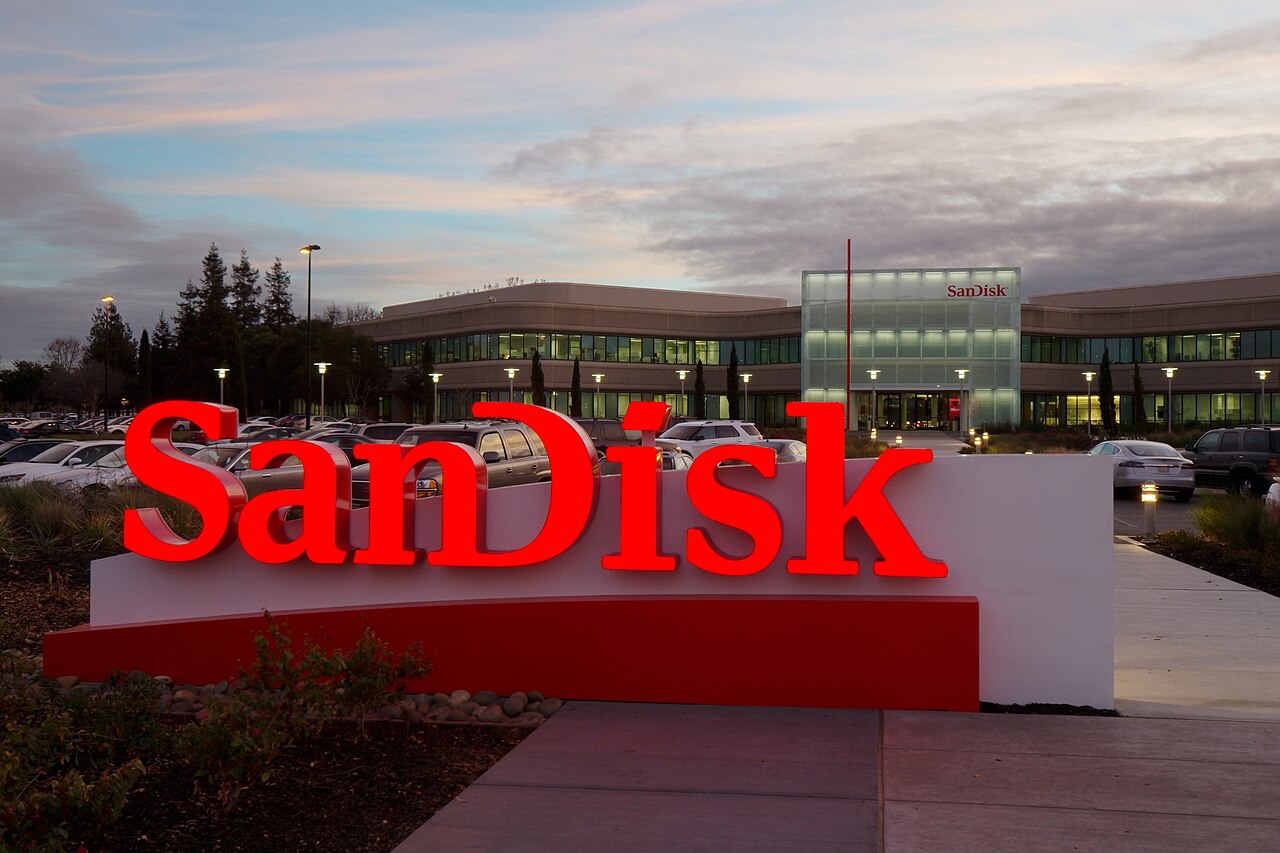
The strategic tipping point is clear. In the “Inference” stage—where AI moves from training to real-world application—the place to permanently store and instantaneously retrieve billions of conversations and unstructured data points is not expensive, short-term memory. We must now redefine SanDisk (SNDK), once dismissed as a mere manufacturer of “USB drives gathering dust in drawers,” as the alpha player controlling the structural essence of AI infrastructure. Behind the flashy computational power, the “massive reservoir”—NAND Flash—has taken center stage in the AI power shift.
2. [Delta 1] The Era of Inference: The Power Shift from ‘Short-term’ HBM to ‘Long-term’ NAND
As the AI paradigm evolves from Training to Inference, the demand structure for memory semiconductors is undergoing a fundamental reorganization. While HBM was the protagonist of the training phase due to its high-speed processing, the volume of cumulative data explodes exponentially during the inference phase where actual services are deployed.
The “625-fold increase in memory demand” projected by Dell and Bank of America is not mere optimism. It reflects a design trend where the required capacity of NAND Flash in AI server architecture is beginning to overwhelm that of DRAM.
[NeuroNest Analysis] The Edge: ‘The Paradox of the Desk (DRAM) and the Bookshelf (NAND)’
In business logic, if HBM is a “narrow, expensive desk that maximizes immediate work efficiency,” then NAND Flash is a “massive bookshelf for storing intellectual assets.” No matter how sophisticated your desk is, if the library’s (Data Center) bookshelves are empty or the retrieval speed lags, intelligence ceases to function. Specifically, NAND latency during inference forces high-end GPUs and HBM into an “Idle” state, incurring massive OpEx (Operating Expense) waste for AI firms. In short, NAND optimization is the “strategic defensive line” protecting AI service margins.
3. [Delta 2] The Supply Vacuum: The ‘NAND Opportunity’ Abandoned by Samsung and Hynix
While global memory giants are engaged in a war of attrition on the HBM front, a peculiar “supply vacuum” has emerged in the commodity NAND market. While Samsung and SK Hynix poured their capital and manpower into the HBM “front line,” SanDisk secured a victory through a “single-well strategy,” effectively monopolizing the NAND “supply route.”
The most critical data point is supply rigidity. Considering the physical constraint that constructing a memory Fab takes at least four years, the investment drought of 2023 has led directly to the current severe shortage. 2026 delivery volumes are already sold out, and preemptive negotiations for 2027 volumes are currently underway. This record-breaking surge of nearly 2,900% ($28 → $900) is not based on mere hype; it is the result of a corporate “Multiple Re-rating” grounded in a “Structural Golden Era” that will persist for years to come.
4. The Heart of Disruptive Insight: Strategic Quotes and Interpretations
The current sentiment permeating the AI infrastructure market is focused not on ‘Cost,’ but on ‘Survival.’
“Rising memory prices may be painful due to increased spending, but a total inability to secure memory signifies the end of the business.”
This quote penetrates the essence of the “Fear and Greed” currently faced by Big Tech. With pricing power completely shifted to the supplier, SanDisk has been elevated from a simple manufacturer to a strategic gatekeeper of AI infrastructure’s lifeblood. The historic stock price appreciation granted by the market is a justified premium for an “irreplaceable resource.”
5. [Delta 3] HBF (High Bandwidth Flash): The Emergence of a New Class Breaking SSD Limits
NAND now rejects the definition of a simple storage device. The emergence of HBF (High Bandwidth Flash), which inherits the stacking logic of HBM, is changing the rules of the game. HBF bypasses the speed limits of traditional SSDs by stacking NAND in parallel, while simultaneously holding a dominant lead in “Power Efficiency”—the greatest challenge for modern data centers.
[Comparison of Memory Semiconductor Types]
| Category | HBM (High Bandwidth Memory) | Standard SSD (NAND) | HBF (Next-Gen Flash) |
| Capacity | Low (Hundreds of GB) | High (Terabytes) | Very High (Stacked NAND) |
| Speed | Ultra-Fast (L1/L2 Class) | Relatively Slow | Fast (Parallel Transfer) |
| Price | Premium (Profit-Oriented) | Low (Commodity) | Mid (Economic Efficiency) |
| Core Value | Training/Compute Optimization | Simple Storage | Inference Accel & Power Efficiency |
[NeuroNest Analysis] The Edge: ‘A Revolution in Power Efficiency for Sustainable Inference’
As AI models grow larger, power saturation in data centers becomes critical. HBF is a “complementary disruptor” that enables large-scale inference while reducing reliance on high-cost, high-power HBM. This provides LLM providers with an escape route to drastically lower inference unit costs, transforming SanDisk from a hardware vendor into an “AI Economic Optimization Partner.”
6. Investment Strategy: The Logic of Beating FOMO and the Aesthetics of Supply/Demand
Ahead of the “Liquidity Event”—the Nasdaq 100 inclusion scheduled for April 20th—the stock price is exhibiting high volatility near all-time highs. While current technical divergence indicates short-term overheating, structural growth remains robust.
Strategic Risk Checklist
- The Harshness of Cyclical Industries: Be wary of a potential “Demand Peak-out” following the NAND price spike. The adage “Sell when memory looks best” remains valid.
- Technical Support Levels: Patience is required to confirm the support at the primary level ($850–860) before scaling in. A break below the $760 trendline necessitates cold-blooded MDD (Maximum Drawdown) management.
- Importance of Fact-Checking: Monitor the governance risks arising from SanDisk’s (SNDK) independent listing status and its potential spin-off dynamics with Western Digital (WDC).
7. The Forward Leap: Is Your Business Ready for ‘Long-term Memory’?
The relentless rally of SanDisk poses a fundamental question to us all:
“Is your AI strategy confined only to fast computation (GPU/HBM), or does it include a blueprint for ‘Long-term Memory (NAND)’ to capitalize on the resulting vast ocean of knowledge?”
SanDisk’s surge is not merely a byproduct of a semiconductor cycle. It is a signal that the intrinsic value of AI—the accumulation and retrieval of data—is finally being reflected in market prices. Computational speed provides a temporary edge, but the depth of stored data determines the longevity of a business.
The moment you close this post, your gaze should move beyond flashy compute chips toward the massive “bookshelf” where that wisdom sleeps. Is your business ready to unlock that knowledge?
Leave a Reply