1. Introduction: The Gap Between Market Fear and Structural Growth
Recently, financial markets have been plagued by extreme volatility, driven by geopolitical risks in the Middle East, threats to the Strait of Hormuz, and the subsequent spike in oil prices. While most investors are reactionary, swayed by headlines and short-term price fluctuations, a seasoned strategist sees an opportunity to pierce through to the core. We must ask ourselves: Is it the intrinsic value of the asset that is shaking, or merely temporary market sentiment?
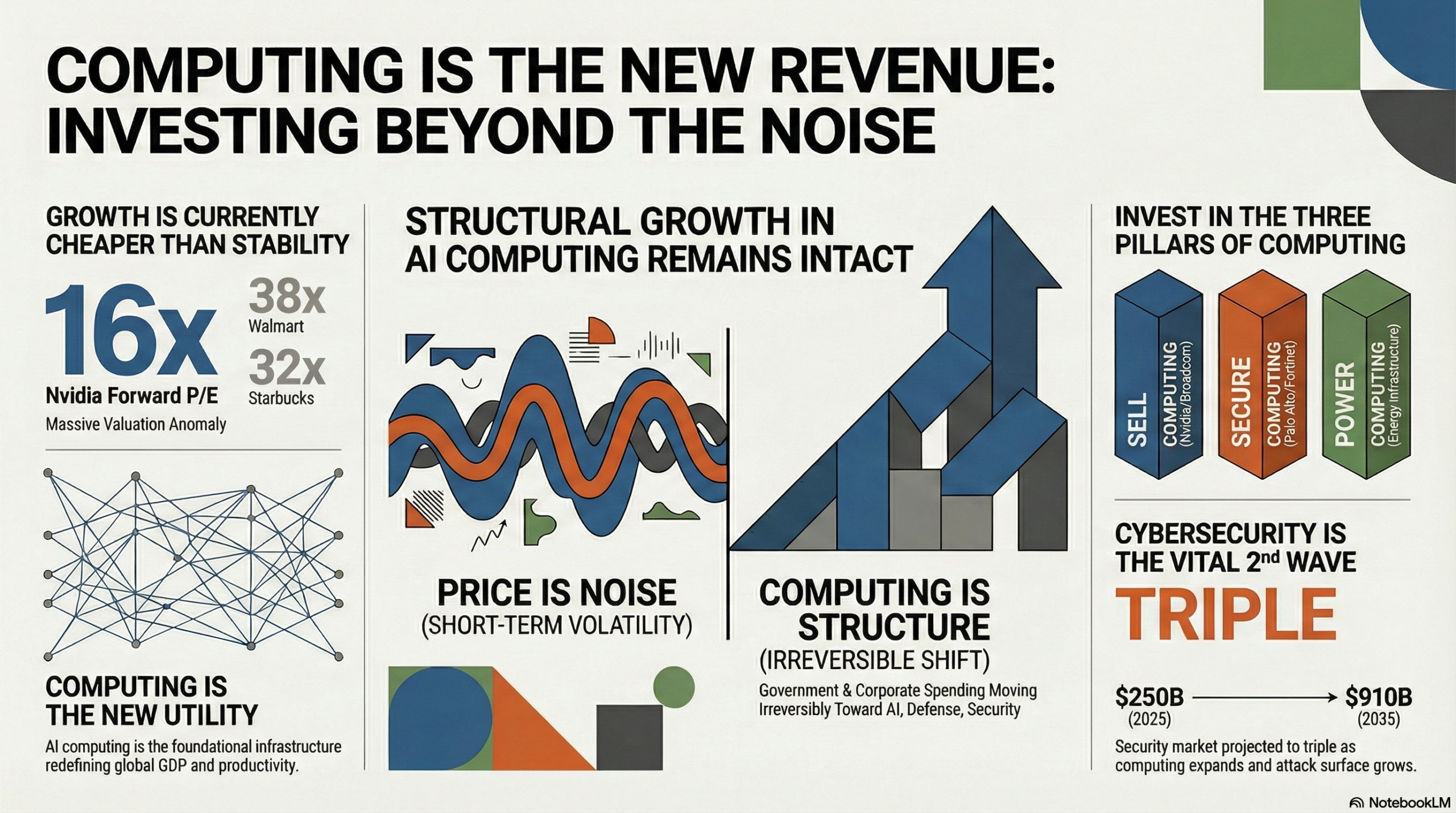
Jensen Huang of Nvidia once stated, “Computation is revenue.” While geopolitical crises are nothing more than short-term “noise,” the global shift toward expanding computational power is an irreversible “structural” change. The price distortions created by current fears cannot derail the industry’s fundamental growth trajectory; rather, they offer a prime entry point to acquire robust fundamentals at a discount.
2. The Valuation Paradox: The Disappearance of the Growth Premium
An anomalous phenomenon is unfolding in the U.S. equity market, defying traditional financial logic. Historically, Big Tech has always commanded a higher premium than consumer goods. Today, however, valuation distortions have intensified to the point where we are witnessing the “evaporation of the growth premium.” The average 12-month forward P/E ratios for growth stocks have converged with those of traditional consumer staples.
The data reveals a stark contradiction. Nvidia, which holds a virtual monopoly on AI infrastructure, trades at a forward P/E of just 16x. In contrast, Boeing (47x), Walmart (38x), and Starbucks (32x)—companies either facing management crises or operating in mature sectors—trade at significantly higher multiples. The fact that a company spearheading a productivity revolution is valued lower than a coffee retailer proves this is a product of psychological oversell, not structural decay. With a current price of approximately $182 and an upside momentum of over 43% relative to IB price targets, Nvidia’s undervaluation is compelling.
3. Follow the Money: Government Spending and Liquidity Trajectory
From a macroeconomic perspective, liquidity is already moving in a definitive direction. Post-pandemic, U.S. government spending as a percentage of GDP remains elevated at 41%. The critical factor is where this capital is being deployed. Major economies are concentrating budgets on “AI, Defense, and Security”—the pillars of national competitiveness—creating sustained structural demand.
Furthermore, an analysis of M2 money supply trends signals a recovery catalyst for asset markets. Following the tightening cycle of 2022, M2 is trending upward again, which typically leads to lower discount rates and higher price sensitivity for growth stocks. As government spending aligns with increasing liquidity, capital will inevitably flow into the massive bottleneck that is AI infrastructure.
4. Expanding the AI Ecosystem: Cyber Security and Power Infrastructure
The exponential surge in computational demand creates inevitable new bottlenecks. Just as electricity enabled the appliance revolution and high-speed internet birthed the streaming market, the proliferation of AI infrastructure necessitates a re-rating of the cyber security and power industries.
- Cyber Security: No longer a mere expense, security is now the critical infrastructure protecting a company’s top line. In an era where computation is a utility, a security breach equates to systemic downtime—and thus, a total halt in revenue. The market is projected to expand to $910 billion by 2035.
- Power Infrastructure: As CEOs from Microsoft to Tesla have warned, “The final bottleneck for AI isn’t chips; it’s power.” Energy infrastructure companies capable of handling the high power density of data centers will enjoy powerful structural growth as secondary beneficiaries of the AI investment cycle.
5. Key Stock Analysis: From Nvidia to Fortinet
| Company (Ticker) | Core Investment Thesis | Target Price (IB) | Remarks |
| Nvidia (NVDA) | Monopolistic core of AI computing; robust data center demand. | $260 ~ $300 | ~43% upside momentum vs. current price. |
| Broadcom (AVGO) | Key leader in networking and custom ASIC chips. | $380 ~ $415 | Infrastructure axis moving in tandem with Nvidia. |
| Palo Alto (PANW) | Leader in integrated security platform strategy. | $235 | Platform lock-in effect; strong secondary beneficiary. |
| Fortinet (FTNT) | Network security powerhouse; excellent valuation appeal. | $92 ~ $130 | Lower direct AI exposure but superior cash flow. |
6. Insight: Defending Labor Income with Capital Income
The ‘2028 Intelligence Crisis Report’ warns of a pessimistic scenario where AI replaces white-collar labor, leading to income reduction and a collapse in consumption/credit. Even if this is a “dark” scenario, investors must face the reality that technological triumph may not align with worker stability.
The most effective survival strategy in this era is to invest in AI capital at a rate that offsets the erosion of your labor value. This is a defensive mechanism, not just a pursuit of profit. As legendary investor Stanley Druckenmiller advised: “Don’t wait for perfect conviction. Enter when you see the signs of change, and maximize your position (sizing) as conviction grows.” Pre-emptively positioning oneself in this structural shift is the ultimate wisdom.
7. Conclusion: March Investment Calendar and Action Guidelines
Short-term volatility tests an investor’s patience, but it provides a clear roadmap for those who believe in industrial structure. Observe these key dates in March:
- March 3 – CrowdStrike Earnings: Confirming the scalability of cyber security demand.
- March 4 – Broadcom Earnings: Verifying the resilience of AI infrastructure and networking hardware.
- March 16 – Nvidia GTC: Reaffirming the next-gen innovation roadmap and market dominance.
- March 18 – FOMC & Dot Plot: Recalibrating the growth stock premium based on liquidity direction.
As a strategist, I leave you with one final question: “Are you afraid of the temporary price, or the permanent structure?” If the structure remains intact, the current noise is a signal of immense opportunity. The eye for essence is what separates capital gains from losses.
“Not a recommendation, just a shared strategic outlook. These are my personal reflections for collaborative study. Trade at your own discretion, share your unique views, and let’s grow together.”
Leave a Reply