1. Introduction: Market Noise vs. The Grand Narrative of AI Infrastructure
The global financial market is currently trapped in a manic-depressive loop. The anxiety of “Mr. Market,” who oscillates between geopolitical tensions in the Middle East and the volatility of oil prices, is merely short-term noise. Beyond this thick fog lies a crystal-clear signal of conviction engineered by Jensen Huang: “The most massive infrastructure construction in human history.”
McKinsey estimates that cumulative global investment in data centers will reach a staggering $6.7 trillion by 2030. Jensen Huang emphasizes that “we have only just invested a few hundred billion dollars,” suggesting that the multi-trillion dollar infrastructure cycle has barely begun. What we must focus on now is not the “ripple” of short-term price fluctuations, but the “ocean current”—how global capital is migrating along the infrastructure channels designed by NVIDIA.
2. The Blueprint: The “AI 5-Layer Cake” and the Era of Vera Rubin
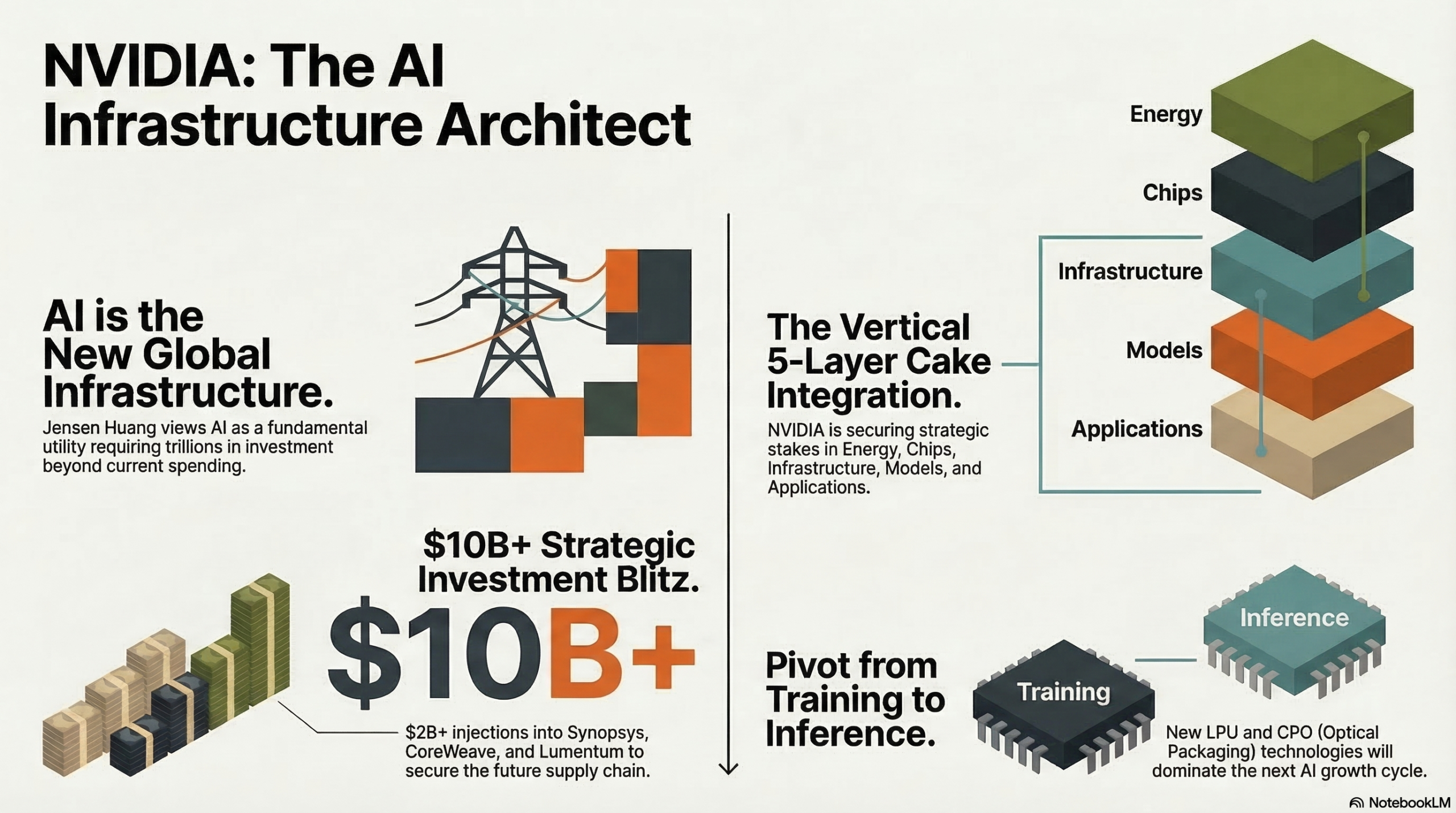
Jensen Huang defines AI not as a mere software tool, but as “Sovereign AI Infrastructure”—a critical facility determining national survival. At the Davos Forum, he outlined the “AI 5-Layer Cake,” signaling the expansion of NVIDIA’s hegemony beyond hardware into the entire ecosystem. The “Vera Rubin” architecture, the protagonist of GTC 2026, is the physical engine that completes this five-layer structure.
| Layer | Core Components | NVIDIA’s Strategic Influence | Strategic Risks & Bottlenecks |
| Layer 1: Energy | Power Grids, Thermal Mgmt | Securing the physical foundation for AI Factory uptime | Power imbalances & cooling limits |
| Layer 2: Chip | Vera Rubin, LPU | Dominant standard & computational efficiency in accelerated computing | Scaling limits & chip fragmentation |
| Layer 3: Infra | Neo-Cloud (CoreWeave, etc.) | Controlling the vertically integrated “AI-only Data Center” supply chain | CapEx oversupply & financing controversy |
| Layer 4: Model | Nemotron | Lock-in via models optimized for proprietary hardware | Competition with open-source models |
| Layer 5: App | Agentic AI | Driving final demand and ROI through productivity gains | Lag in real-world business value creation |
NVIDIA is directly constructing a dedicated “circuit” where the powerful “Vera Rubin” engine can run most efficiently by injecting capital across all five layers.
3. The Circular Economy of Capital: The “Two-Billion Dollar Club” and the Paradox of Vendor Financing
NVIDIA’s recent large-scale investments of over $10 billion are not simple equity acquisitions. It is a sophisticated strategy to create a “Circular Capital Flow,” where NVIDIA’s invested capital eventually returns as revenue through the purchase of its own chips.
- The Vanguard of Neo-Cloud (CoreWeave & Nebius): NVIDIA injected $2 billion each into CoreWeave (operating at 850MW) and Nebius (planning a 5GW system). They serve as NVIDIA’s frontline, being the first to receive “Vera Rubin” chips to build out massive data centers.
- Breaking Technical Bottlenecks (Synopsys & Lumentum/Coherent): Investments in EDA leader Synopsys and CPO (Co-Packaged Optics) leaders Lumentum/Coherent represent a resolve to break through the physical limits of productivity and data transfer speeds.
- The Trojan Horse of the Model Layer (Nemotron & Thinking Machine Labs): Investing in Thinking Machine Labs, founded by former OpenAI CTO Mira Murati, signifies a move to dominate the upper layers. The Nemotron model, which runs 7.5 times faster on NVIDIA hardware, marks the beginning of a “software monopoly” that naturally locks users into the NVIDIA ecosystem.
While this “Vendor Financing” model provides massive liquidity and accelerates growth, it also invites criticism regarding valuation bubbles. However, Huang remains firm in his manufacturing-based conviction: “Productivity creates capacity, and capacity creates growth.”
4. GTC 2026 Game Changers: A Paradigm Shift in Connectivity and Memory
Market interest is shifting from pure raw compute to “bottleneck resolution.” The next-gen technologies to be unveiled at GTC 2026 symbolize the transition from the “Age of Training” to the “Age of Inference.”
- ① CPO (Co-Packaged Optics): The End of Copper and the Arrival of Photonic RailsTraditional data centers are like “massive conveyor-belt sushi restaurants” using narrow, slow copper wires. As data volume grows, power consumption and latency become unsustainable. CPO is an innovation that packages the kitchen (chip) and the belt (optics) into one, allowing data to move at the speed of light. NVIDIA’s investment in Lumentum and Coherent is a move to preempt the supply chain for these “photonic rails.”
- ② LPU and ICMS: The “Central Library” System for Agentic AIIn the era of “Agentic AI,” where inference workloads explode, NVIDIA is internalizing LPU (Language Processing Unit) technology. Furthermore, ICMS (Inference Context Memory Storage) is akin to building a massive “Central Library” accessible to all students simultaneously, rather than small individual bookshelves (traditional GPU memory) in each classroom. This is the key to solving the chronic KV cache memory explosion.
5. Strategic Bottom Line: Three Cold Truths for Investors
In the vortex of this massive infrastructure cycle, investors should maintain the following strategic stances:
- Decouple Time Horizons: Do not weigh geopolitical crises (weeks/months) against the AI infrastructure cycle (5–10 years). For those who understand the essence of the long-term cycle, price corrections driven by short-term noise are opportunities.
- The Spillover of Vertical Integration: Focus on sectors enjoying monopoly-like status within NVIDIA’s “5-Layer Cake” strategy, such as CPO (Optical), HBM (Memory), and Neo-Cloud operators. The dominance of key partners like SK Hynix (HBM) will only strengthen.
- Avoid Leverage and Value Strategic Cash: Remember the adage: “Even the best asset becomes a burden if bought too high.” Excessive leverage is fatal during high volatility. Maintaining cash to “buy the dip” will determine long-term victory.
6. Conclusion: The Duel of Energy Independence and Infrastructure Sovereignty
Crisis and opportunity are two sides of the same coin. Paradoxically, the energy crisis in the Middle East stimulates the desire for “Energy Independence,” which will accelerate investment in efficient AI infrastructure and next-gen energy tech. The multi-trillion dollar AI infrastructure war designed by NVIDIA has just entered a state of total war. Only those who understand the circular structure of capital and read the direction of technological hegemony will enjoy the fruits of this era-defining shift.
“Not a recommendation, just a shared strategic outlook. These are my personal reflections for collaborative study. Trade at your own discretion, share your unique views, and let’s grow together.”
Leave a Reply