1. Introduction: Perfect Numbers, So Why Is the Market Signaling a ‘Structural Breakdown’?
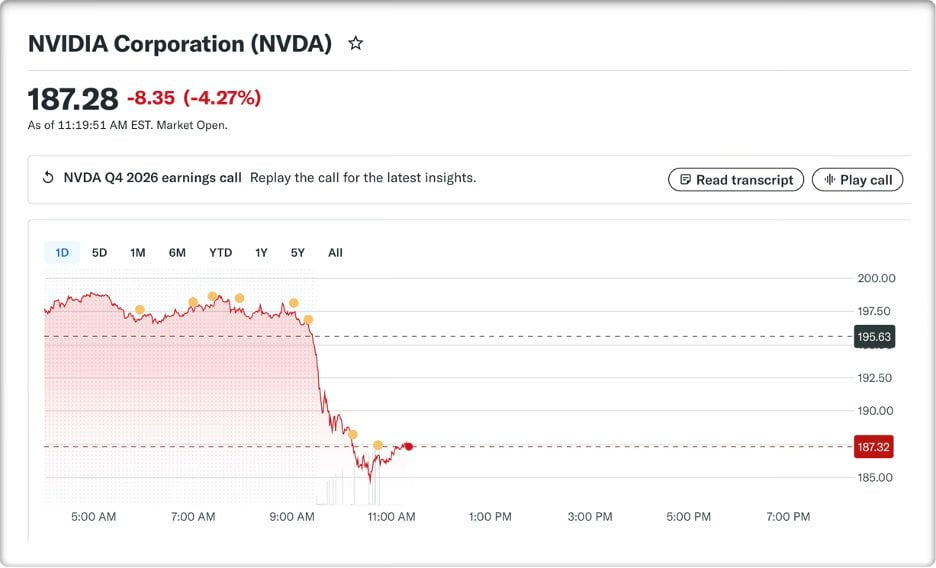
The global macro environment has shifted beyond a mere “clash between expectations and reality” into a massive paradigm shift. Despite Nvidia releasing overwhelming earnings that defied market forecasts, the response was a cold, sharp sell-off. This is not a simple “sell the news” event. It is a “crack in conviction”—a signal that the market will no longer pay a premium for the abstract promise of an AI-driven future. Investors have begun to scrutinize the quality of growth.
Compounding this is the geopolitical bombshell of Israeli airstrikes on Iran. The gravity is underscored by President Donald Trump’s declaration that a “major battle has begun.” Current volatility isn’t just a correction; it is the prelude to a structural breakdown of Nasdaq’s dominance. One must capture the hidden opportunities behind why Wall Street’s “smart money” is dumping tech to pivot toward cash and Asia.
2. The Warning from Nvidia and Microsoft: The Vanishing Growth Premium and the “Cash War”
The most jarring data point in the U.S. market today is that Big Tech valuations have regressed to the levels of consumer staples like Coca-Cola or P&G. This suggests investors are reclassifying Big Tech from “high-growth” to “cyclical” or “cost-intensive.”
- Nvidia’s (NVDA) “Shocking” Valuation: Despite a staggering 75% margin and 94% dominance in the data center market, its Forward P/E has compressed to 16.45. This is deep historical undervaluation. At $177, the stock is perilously testing the $160 psychological floor (near the 200-day moving average).
- Microsoft’s (MSFT) Humiliation: Down 30% from its peak, MSFT is on the verge of breaking its 200-day line for the first time since 2022. Massive AI capital expenditures (CAPEX) are being weighed down by an uncertain pace of monetization.
| Category | Big Tech (NVDA, MSFT, etc.) | Consumer Staples (KO, PG, etc.) | Spread |
| 2021 Peak | P/E Premium Maximized | Relatively Undervalued | +20 or higher |
| Current State | 10-Year Historical Low | Inflow of Defensive Buying | Below 0 (Inverted) |
| Market Implication | Collapse of Growth Expectations | Rediscovery of Stable Cash Flow | Valuation Trap Alert |
Strategic Insight (The Cash War): The market no longer buys “dreams”; it buys cash. Note that OpenAI secured a $160 billion investment in all-cash, and Warren Buffett’s Berkshire Hathaway is sitting on a record $382 billion in cash. In an era of high interest rates and high costs, cash is not just an asset—it is a weapon for survival.
3. The Middle East Powder Keg and “Trump-War” Dual Beneficiaries: The $120 Oil Scenario
Tensions in the Strait of Hormuz (through which 20% of global oil flows) are not merely an energy issue. They represent the reignition of inflation and a halt to Fed rate cuts.
- Oil Price Scenarios:
- $80: Current tension maintained (Neutral).
- $100: Partial supply disruption. Inflation fears spread.
- $120: Total blockade and military conflict. A “catastrophe scenario” for tech and airline stocks.
- Sector Hedge Strategy: Energy ETFs (XLE) and oil majors (XOM, CVX) are essential shields for any portfolio.
- Deep Dive – Howmet Aerospace (HWM): Positioned at the intersection of Trump’s defense spending hikes and infrastructure policies. HWM holds a monopoly on engine components for both military (RTX, GE) and commercial (Boeing, Airbus) aircraft. Its “Dual-Market Hedge” structure ensures robust returns amidst geopolitical turmoil.
4. Global Asset Rotation: U.S. Stagnation vs. K-Market Re-rating

While the Nasdaq flails in a valuation trap, smart money is accelerating a global rotation out of the U.S. and into Asia, specifically South Korea.
- U.S. Stalls, Korea Soars: While the S&P 500 has essentially gone nowhere this year, the Korean market has outperformed Taiwan (16.1%) and Japan (13.5%) to lead global returns. Samsung Electronics climbing to 13th in global market cap (rivaling Walmart) signals the start of a “Value Re-rating.”
- Migration to Safe Havens: Even aggressive investors are shedding Nasdaq themes in favor of “Dollar SOFR (Secured Overnight Financing Rate) ETFs.” This defensive positioning allows one to capture yields at the U.S. benchmark rate without price volatility, while waiting for the next entry point.
5. Strategic Bottom Line: A 3-Step Mandate to Navigate “Volatility Week”
Bearish sentiment is nearing 40% as fear takes hold. However, remember: when bearish sentiment hit 61.9% last April, it was paradoxically the best buying opportunity. Now is the time for cold-blooded portfolio rebalancing, not panic selling.
[Wall Street Strategist’s Action Checklist]
- Monitor the “Fear Calendar”: Brace for a “Volatility Week” featuring earnings from CrowdStrike (3rd), Broadcom (4th), Costco (5th), and the Unemployment Report (6th).
- Defend Technical Thresholds: Nvidia’s ability to hold $160 is the linchpin for the trend. If this breaks, reducing exposure is a necessity, not an option.
- Weaponize Cash: Emulate Berkshire Hathaway by liquidating a portion of your portfolio to build a “war chest” for dip-buying. Utilize Dollar SOFR ETFs as a high-yield cash vault.
As Charlie Munger said: “The big money is not in the buying and the selling, but in the waiting.” Until the Nasdaq bubble settles and true fundamentals emerge, only those who prepare with patience will lead the next bull run.
“Not a recommendation, just a shared strategic outlook. These are my personal reflections for collaborative study. Trade at your own discretion, share your unique views, and let’s grow together.”
Leave a Reply