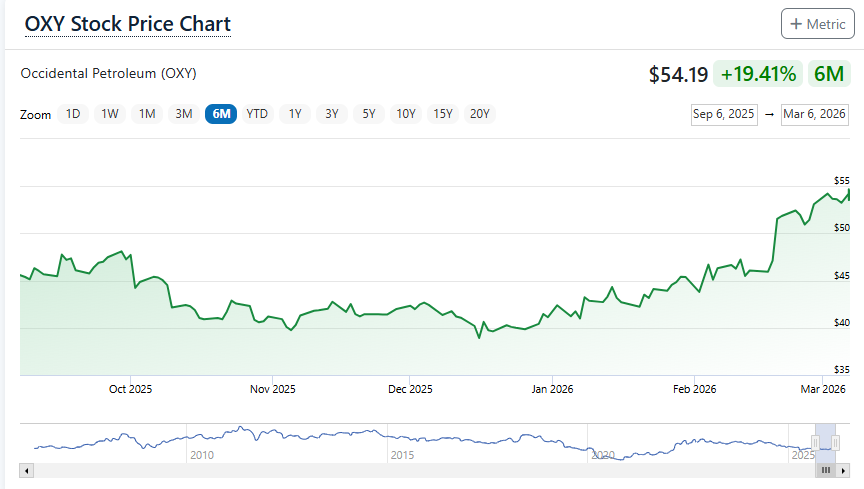
Over two decades of navigating the volatile tides of global markets, one lesson stands above all: when the masses succumb to panic, the strategist must look beyond the noise and redraw the map of capital allocation. As international oil prices breach the $90 mark and geopolitical tensions reach a fever pitch, I have stepped away from the market clamor to execute a cold, calculated decision.
1. Introduction: Liquidating Energy Positions — A Record of Strategic Capital Recycling
Strategic investing is the art of harvesting the fruits of patience. After nearly two years of holding Occidental Petroleum (OXY)—including eighteen months of enduring what many would call a stagnant, underwater position—I have liquidated my entire stake as oil prices surged past $90.
This exit, however, is not a mere profit-taking exercise. The current spike in oil is a fragile ascent built on the noise of geopolitical risk rather than a fundamental improvement in supply and demand. I define this move as Strategic Capital Recycling—protecting asset value to deploy it where it matters most. As the fear of $100 oil begins to weigh on the market, we must confront the far more ominous cloud on the horizon: stagflation.
2. Fractured Optimism: The 3M Framework vs. Market Reality
Just 48 hours ago, J.P. Morgan released a bullish report suggesting that the worst of the volatility had passed. Their logic was anchored in the 3M framework: Munitions (depleting stocks), Markets (resilient reaction), and Midterms (the U.S. administration’s need to de-escalate). For a moment, as Iranian missile counts appeared to dwindle, this scenario gained traction.
Yet, this optimism evaporated in an instant. President Donald Trump’s declaration on Truth Social—asserting that there would be no deals with Iran, only unconditional surrender—sent shockwaves through the pits. WTI crude surged past $90, and the Dow Jones Industrial Average’s year-to-date returns flipped into negative territory. With reports of suspended oil tanker traffic and a looming shortage of storage facilities in the Middle East, the foundation of market optimism has effectively collapsed.
3. Vertiginous Macro Indicators: When the Fed’s Toolbox Runs Empty
The “nausea” currently felt by investors is the visceral realization of a worst-case scenario: stagflation. The February non-farm payroll data delivered a crushing blow to the market. While analysts expected a gain of 55,000 jobs, the actual figure was a staggering loss of 92,000.
Coupled with skyrocketing oil prices, the Federal Reserve now finds itself in a paralyzing dilemma. Raising rates to combat energy-driven inflation will likely collapse a labor market that is already showing cracks. Conversely, cutting rates to stimulate employment will allow energy-led inflation to burn out of control. The Fed is running out of tools to manage both crises simultaneously.
The omens of liquidity stress are already singing. BlackRock’s decision to cap redemptions on its private credit fund at 5% is the proverbial canary in the coal mine. When the CEO of United Airlines warns of a fatal blow to Q1 earnings due to fuel costs, we must recognize that the cracks in the real economy have already formed.
4. Reallocating Assets: Why AI Remains the Destination Amidst Peak Fear
When the market discards technology stocks in a fit of panic, we must redefine the nature of our assets. If oil is a geopolitical tax imposed on the economy, then AI is the deflationary engine that innovates productivity and slashes costs.
While news of the scale-back in the OpenAI-Oracle “Stargate” project made headlines, Meta has aggressively stepped into that vacuum, armed with Nvidia’s next-generation silicon. This proves that AI demand is no longer just about expansion; it has evolved into a high-stakes war for dominance among titans. Marvell Technology’s robust earnings, driven by AI infrastructure, further underscore the iron-clad fundamentals of this sector.
Currently, the forward P/E of the M7 (Magnificent Seven) stands at 26x—lower than the historical average of 29x. While the window of geopolitical conflict may persist for the next four to six weeks, I will use my newly secured cash to build positions in Nvidia and Palantir. My strategy is not a singular “all-in” move, but a disciplined, staggered entry over a six-week timeline. The high balance in the U.S. Treasury General Account (TGA) serves as the policy “dry powder” that should prevent a total market collapse.
5. Conclusion: Jesse Livermore’s Patience and the Migration of Capital
The legendary Jesse Livermore once remarked that his greatest fortunes were made not through his “thinking,” but through his “sitting”—his waiting. During World War II, those who dumped their shares at the height of the military crisis missed the historic rally that saw the Dow breach 500 within five years.
The sensationalist headlines and oil price fluctuations of the hour are designed to paralyze your reason. Remember: the stock market is, at its core, a mechanism for transferring wealth from the impatient to the patient. By shifting from short-term energy trades to the structural growth of AI, we position ourselves on the right side of history. Stay composed, focus on the intrinsic flow of the market, and let your patience be your victory.
“Not a recommendation, just a shared strategic outlook. These are my personal reflections for collaborative study. Trade at your own discretion, share your unique views, and let’s grow together.”
Leave a Reply