1. Introduction: When Market Noise Masks Structural Reality
The current financial landscape is saturated with sensational headlines: USD/KRW breaching 1,500, escalating tensions in the Strait of Hormuz, and spiking crude prices. While the masses succumb to the fear of geopolitical risk, the contrarian strategist looks beyond the noise to find the structural flaw.
The current surge in oil is merely a “trigger”—a tactical smokescreen distracting the market. The true antagonist is the fracture in the Private Credit market. Private credit is the massive shadow banking ecosystem birthed by the excessive liquidity of the low-interest-rate era. Unlike geopolitical skirmishes, the “Stealth Bank Run” occurring within these financial arteries causes structural damage that, once broken, is nearly impossible to mend. We must look past the smoke to see how this credit seizure is driving the global shift in the real economy and the AI revolution.
2. The Stealth Bank Run: Warnings from Blackstone and Blue Owl
Private credit funds grew exponentially by providing high-interest capital to mid-market firms cut off from traditional bank loans. However, this model harbors a fatal flaw: Liquidity Mismatch. Their underlying assets (loan receivables) are illiquid and hard to exit, yet investors demand immediate redemptions during periods of uncertainty. This anxiety triggers a fear of “Gating” (suspension of redemptions), acting as a feedback loop for panic.
Recent indicators from industry titans suggest these fissures have reached a breaking point:
| Indicator | Data & Context | Notes |
| Standard Redemption Limit | Max 5% per quarter | Industry standard cap |
| Blue Owl Redemption Requests | 17% | Panic selling triple the limit |
| Blackstone Redemption Requests | 7.9% | 2.9% above the 5% cap |
| Blackstone Emergency Liquidity | $8 Billion (approx. 10.7T KRW) | Cash deployed to meet redemptions |
Blackstone’s aggressive use of its own balance sheet and employee capital to signal “safety” is a double-edged sword. It paradoxically highlights that smaller funds, lacking such massive cash reserves, have no alternative but to gate. The survival struggle of the giants is a harbinger of a potential domino effect among mid-sized managers.
3. The AI Backlash: Where Zombie SaaS Meets Credit Risk
Morgan Stanley identifies “AI-excluded firms” as the primary detonator for this private credit crisis. The essence of the risk is not “Market Risk” (fluctuating stock prices), but “Credit Risk”—the fundamental inability to recover principal.
- The Origin of Malaise: During the 2021–2022 era of cheap money, private credit funds aggressively lent to legacy software firms, seduced by the “Stable Subscription Revenue (SaaS)” narrative.
- Destruction by AI: The AI revolution is fundamentally dismantling the business models of these legacy SaaS firms. As their competitive edge vanishes, so does their capacity to service debt.
- Chain Reaction: As the underlying assets decay, private investors are hitting the redemption button, further draining liquidity from the private credit market in a vicious cycle.
4. KOSPI’s Vulnerability: The Calculus of Won Beta and Liquidity Exodus
Fractures in private credit inevitably lead to global liquidity withdrawals. Capital in need of immediate cash flees the “ATM of Risk Assets”—emerging markets. The KOSPI is particularly besieged due to the high Beta of the Korean Won (KRW).

Private Credit Gating → Global Liquidity Seizure & Risk-off Sentiment → Flight to Safety (USD) → Sell-off of High-Beta Currencies (KRW) → Foreign Capital Flight → KOSPI Contraction.
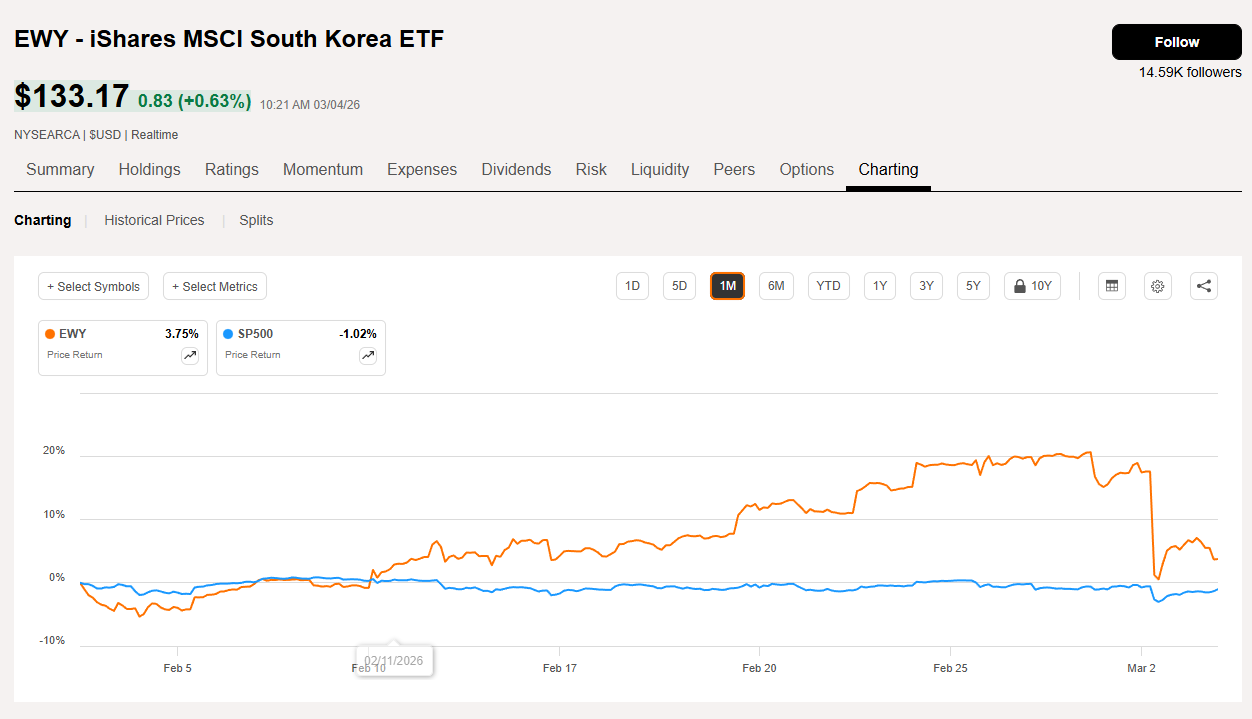
According to Bank of America (BofA), the KRW is among the most volatile currencies during global economic shocks. The record-breaking foreign sell-off recently observed in Samsung Electronics should be interpreted not as a verdict on the company itself, but as “forced liquidation” by foreign institutions managing their global credit exposure.
5. Contrarian Strategy: Favoring Tangible Manufacturing at the Peak of Fear

The current KOSPI drawdown is an irrational sell-off driven by the “External Liquidity Environment” rather than a degradation of intrinsic value. Herein lies the paradoxical opportunity.
The same “AI Revolution” that is collapsing the private credit-backed software sector is a powerful engine for Korea’s core manufacturing. While SaaS firms are being replaced, the hardware fundamentals required to physically manifest AI—Semiconductors (Samsung, Hynix), Power Grids, and Robotics—remain stronger than ever.
When the US private credit crisis vacuums up global liquidity and pressures the KOSPI, we are granted an entry point to buy the “Tangible Assets” of the AI era at depressed valuations. The cause of the drop is Credit; the justification for the recovery is Tangible Demand.
6. Strategic Bottom Line: 3-Point Checklist for Navigating the Crisis
- Monitor Oil Downside Catalysts: Events that break the oil rally (e.g., nuclear negotiations, production hikes) will be the first signals to halt KRW depreciation and reverse foreign outflows.
- Track High-Yield Spreads & Gating Contagion: Watch for the spread of redemption suspensions to mid-sized managers and spikes in high-yield spreads to gauge the market floor.
- Portfolio Fortification: Ensure your cash flow can withstand volatility. If individual stock picking is too taxing, use index-based ETFs (e.g., EWY) with high exposure to Samsung and Hynix for a disciplined DCA (Dollar Cost Averaging) approach.
7. Conclusion

Geopolitical fear is like a storm; it paralyzes reason. However, the data points to a clear reality: the current agony is a “Liquidity Tantrum” occurring as legacy bad debts are purged to make way for an AI-centric real economy. Assets with surviving fundamentals inevitably return to their true value once the storm passes. For the prepared investor, the current noise is not a crisis—it is the source of future alpha.
“Not a recommendation, just a shared strategic outlook. These are my personal reflections for collaborative study. Trade at your own discretion, share your unique views, and let’s grow together.”
Leave a Reply